
Lake Chalco is a beautiful ancient lake in central Mexico. Historically, it is of great importance for the cultural development of these territories.
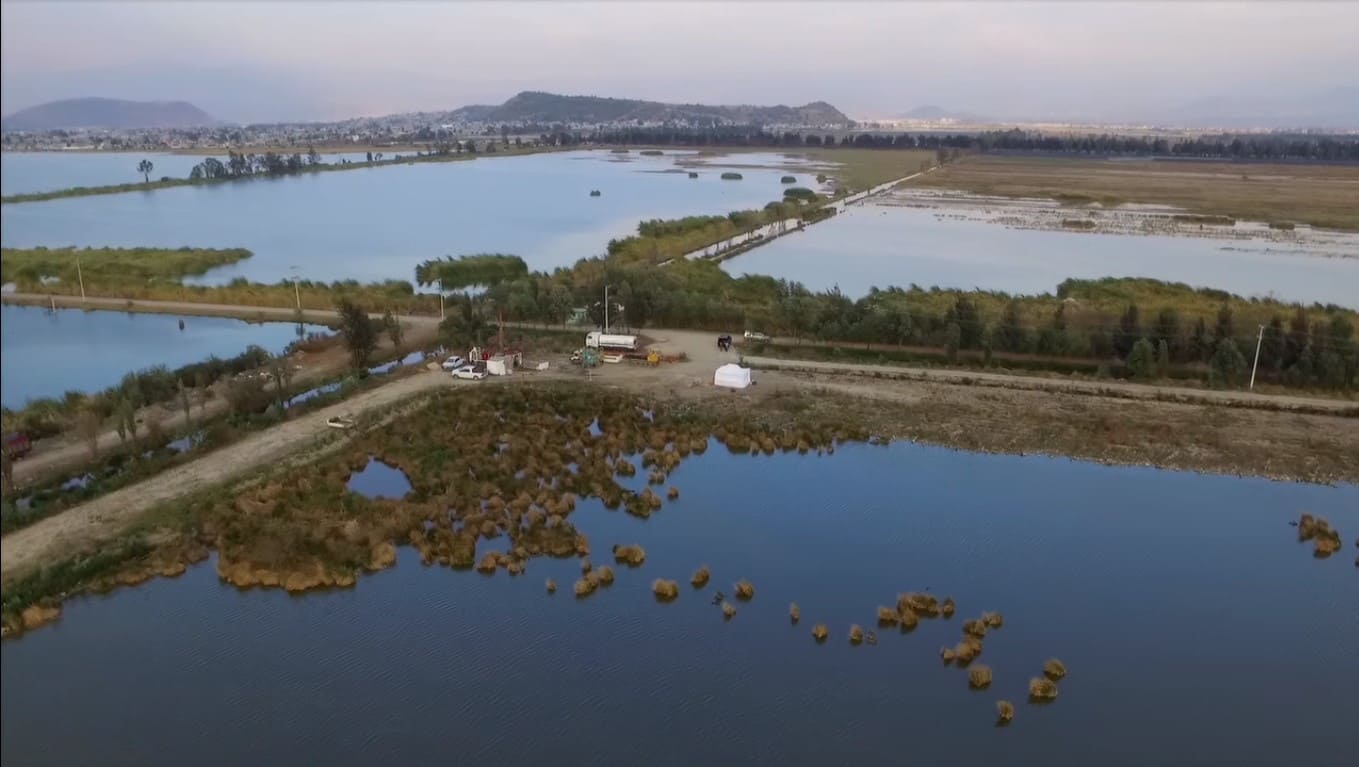
The Chalco characteristics
- Coastline is 12 miles
- Depth: shallow — only a few metres (Chalco was always a shallow valley lake)
- Length is 2 miles
- Width is 420 feet at the narrowest and 5.280 feet at the widest place
| What it is | An ancient freshwater lake of the Valley of Mexico — mostly drained over a century ago, and now partly reborn as a “new” lake |
| Where | Southeast of Mexico City, in the State of Mexico (the Chalco / Valle de Chalco plain), about 30 km from the city centre |
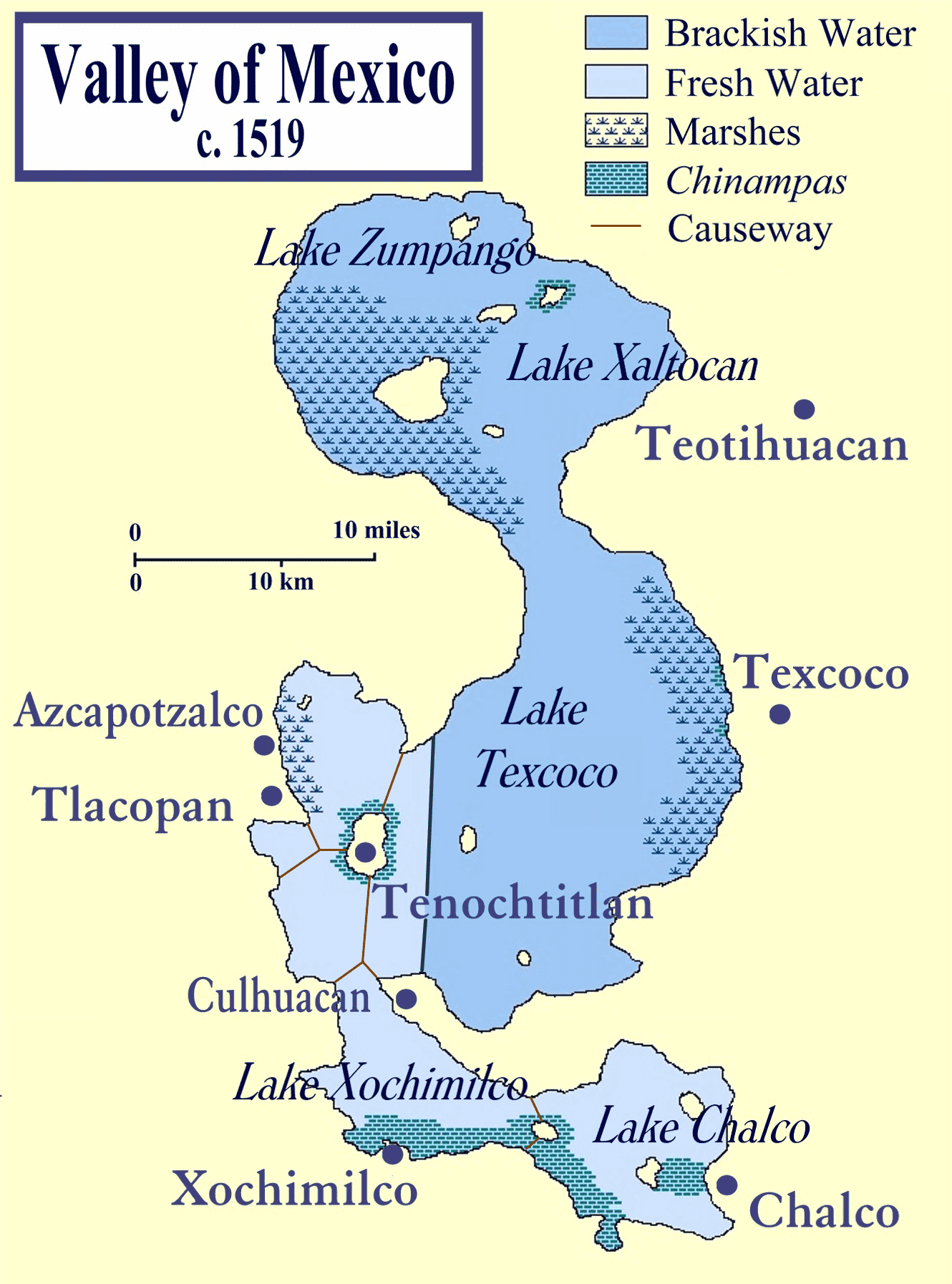
| Part of | The five-lake basin of the Valley of Mexico, with Xochimilco, Texcoco, Zumpango and Xaltocan |
| Famous for | Aztec chinampa farming, the 25,000-year-old Tlapacoya archaeological site, and a remarkable disappearing-and-returning lake |
| Today | A quiet, local spot for walking and cycling in lakeside parks — and a textbook case of land subsidence |
The lake that came back: subsidence and the “new” Lake Chalco
Lake Chalco has one of the strangest stories of any body of water in Mexico: it was deliberately wiped off the map, and then it quietly returned. Drainage that began in Aztec times was finished off in the late nineteenth century, when the landowner Iñigo Noriega drained the last of the lake around 1895 to win farmland from the lakebed. For most of the twentieth century Chalco was simply a dry plain filling up with houses. Then the ground started to sink. Decades of pumping drinking water from the aquifer beneath the plain caused the soft clay to compact and the surface to drop — in places by as much as 40 centimetres a year — until a basin formed that now sits more than a dozen metres below the old ground level. Rain and seepage pooled in it, and a shallow “new” Lake Chalco was born in the 1980s and has been spreading ever since, ringed by the city of Valle de Chalco, whose neighbourhoods it periodically threatens to flood. It is one of the clearest, and most worrying, examples of land subsidence anywhere in the world.
Tlapacoya: 25,000 years of history on the shore
On the lake’s former southeastern edge rises the hill and small volcano of Tlapacoya, and it hides one of the oldest human stories in the Americas. Hunters camped on these shores and in the caves above them as far back as 10,000 to 40,000 years ago, and bones and tools recovered here have been dated to roughly 25,000 years — among the earliest traces of people anywhere on the continent. Much later, between about 1500 and 300 BCE, Tlapacoya became a thriving Preclassic village famous for its exquisite little clay figurines, linked to the Tlatilco culture. Standing on the dusty rise today, with the resurgent lake glinting below, you are looking at a place that has been continuously important to human beings for an almost unimaginable span of time.
The freshwater heart of the Aztec lake system
In the days of the Aztecs, Chalco was the sweet-water jewel of the valley. Fed by artesian springs along its southern shore, it stayed fresh while the great Lake Texcoco to the north turned salty, and that fresh water made it perfect for chinampas — the raised garden plots that fed the empire. Together with neighbouring Lake Xochimilco, Chalco formed an 18,000-hectare patchwork of canals and floating fields so valuable that the emperor Itzcoatl conquered the whole southern lake region to control its harvests. The axolotl, the salamander now clinging on in Xochimilco, was once at home in these waters too. Chalco may be the quietest of the valley’s lakes today, but it was once its breadbasket.
History
Since ancient times, the lake was named after the city of Chalco. Artesian springs are the main source of water for the lake. When the Aztec epoch existed, it was possible to grow wide floating gardens, which are called Chinampa.
The name of the floating gardens is associated with the ancient name of the southwestern part of Mexico, the region of Xochimilco – Chinampan. Since those times, such a cultivation technique has become famous and remains popular until now.
The gardens consist of several narrow islands up to 35 feet wide and up to 650 feet long. Thanks to the lake, the soils of the gardens receive enough moisture and fertilizer for productive cultivation.
Since the time of the Aztec settlements and ending with the 20th century, people have tried to drain Lake Chalco and the nearest water bodies. Local tribes were afraid of the onset of floods characteristic of this area. After the process of draining and volumetric consumption of fresh water, the lake became unsuitable for growing floating gardens. Now we can see only a small part of it.
Wild animals and plants on Lake Chalco
This place is full of wildlife. However, over time, the number of animal and plant species decreased significantly due to soil salinity and aridity of the territories. From plants now you can meet here:
- Eucalyptus
- Pepper Tree
- Pines
The fauna is mainly represented by aquatic creatures. The most famous representative, the monster of these waters is an axolotl. This is a type of salamander that lives only in the central regions of Mexico, including Lake Chalco. This interesting animal is still under the close supervision of scientists.
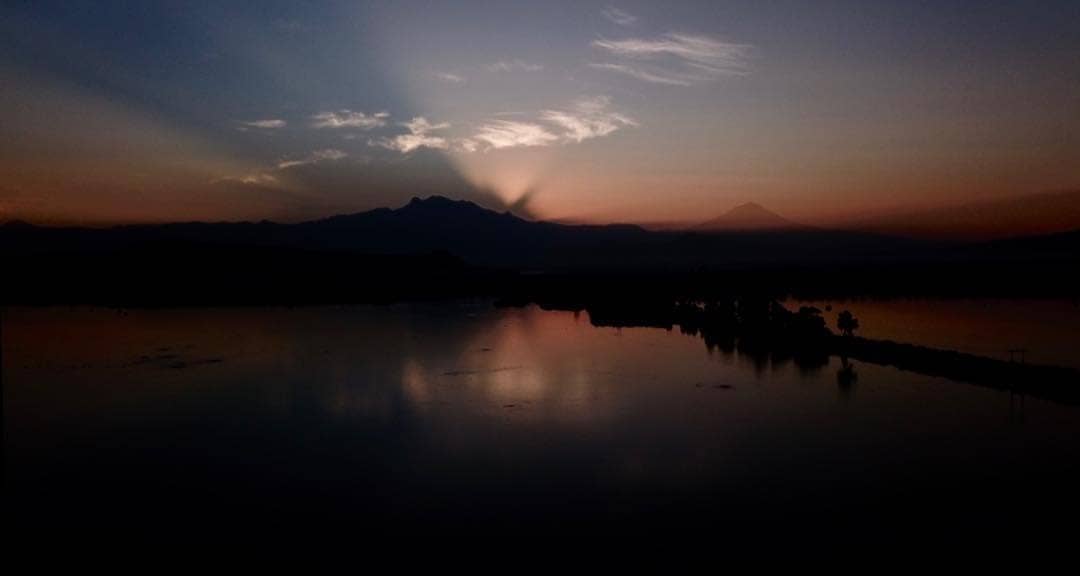
Nevertheless, despite the not very diverse variety of flora and fauna, the lake still has a magnificent landscape, sunrises and sunsets.
Parks near Lake Chalco
If you have already fled the coast of the lake and want to see new places, then by all means go to Xicotencatl Park. This green and spacious park is located 1.6 miles from the eastern shore of the lake.
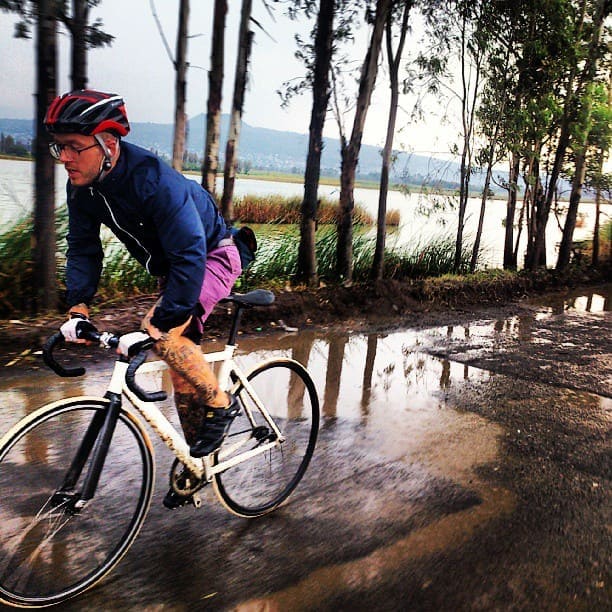
The city park is designed for hiking, cycling, rollerblading and various sports games. As a rule, there are few people here. Therefore, everything here has for solitary rest or exercise in the fresh air.
Next to Xicotencatl Park is Ecological Park Xico. This is a small cozy park. There is no less beautiful and picturesque, so do not go around with it and visit in your days of rest.
Both city parks are open 24 hours a day and have free access for all visitors. Also here you can freely walk with your favorite pets.
There is a modest national park La Caldera 3 miles from the northern part of the lake. Here, too, a calm atmosphere reigns and there are all conditions for a family holiday or walking with friends. You can eat in the cafe and drink hot aromatic coffee in the park.
How to weekend on the lake
Lake Chalco is not a typical lake. There is no noisy entertainment, amusement park and loud celebrations. This is a peaceful place where you will find peace. This is the perfect place to do yoga, meditation, quiet workouts. If you like to ride a bike is great! The park has a large area for comfortable cycling.
Beautiful cities around
The brightest and most famous cultural and historical center is, without doubt, Mexico City. The city center of the state capital is located 18 miles from the lake.
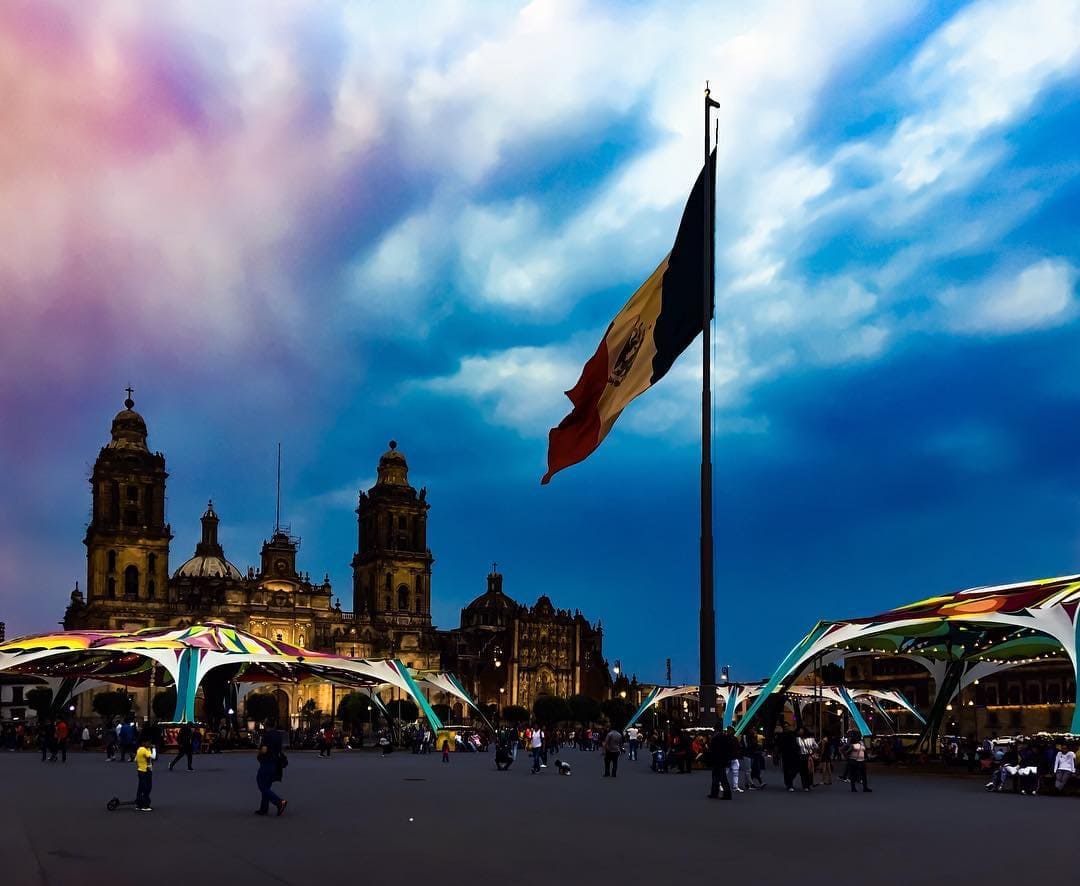
Once in Mexico, first go to the main square of the city Zócalo. Here you can see palaces, historic buildings, beautiful streets, temples. One day is not enough for you to go around all these places.
If you literally don’t transfer museums to the spirit, forget about it and visit the Anthropology National Museum. This is the most important museum in Mexico, which allows you to learn the culture of the country from all sides. And by the way, it is in the 10 best museums in the world.
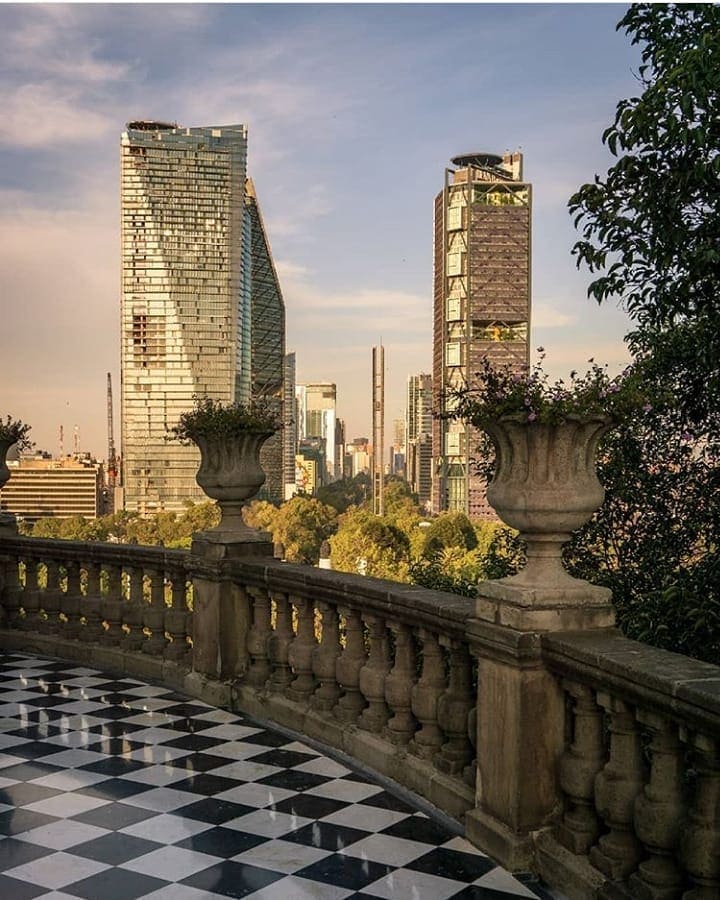
And the museum is located in a huge park Chapultepec. Here, too, a lot can be seen and make beautiful photos for memory.
All you need to come to the square is the metro. Fortunately, the public transport network is well developed in Mexico. It’s simple: you need 2 metro lines in blue, Zocalo station.
And to get to the museum, you will need red line №1 and get off station
Chapultepec.
Comfortable life on Lake Chalco
On Lake Chalco, there are no campgrounds for a long rest. But on the coast, there are many hotels and guesthouses with excellent rooms and apartments.
If silence, comfort, and tranquility are what you want from life, then you will like the area of Lake Chalco.
The district, although not crowded, is equipped with comfortable and reliable houses. For 178,000 US dollars you can find a great housing option with a nice courtyard. Like this one.
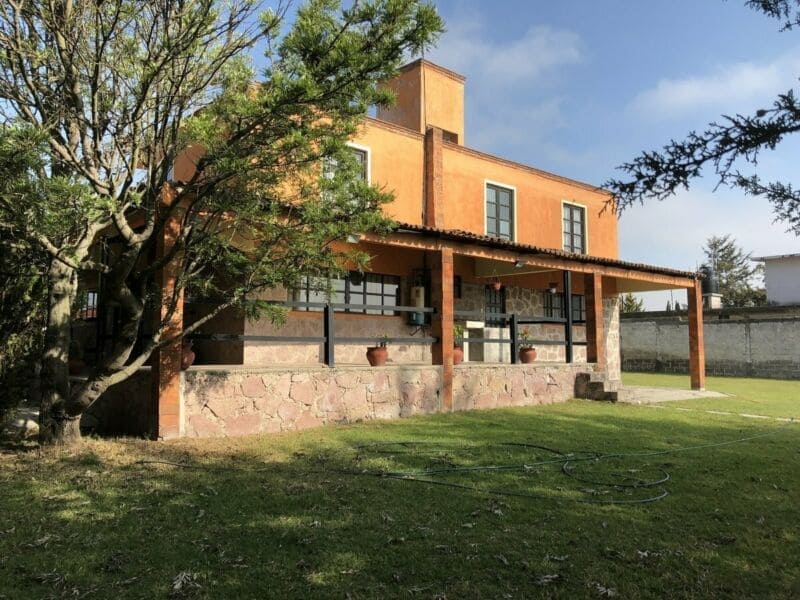
There also exists many budget offers from 78,000 US dollars in gated area with shared swimming pool.

Friendly neighbors, a warm climate and a wonderful landscape make Lake Chalco a wonderful place to stay.
The best way to get to Lake Chalco
From the main airport of Mexico
It is about 20 miles from the airport of Mexico City to the lake.
It is best to get from the airport to any metro station by public bus. And then you should go to the station Tlahuac (M12). From the metro station, it is worth taking a taxi. You will spend only 10-15 minutes to go to the lake. A taxi ride will cost you about 5 US dollars.
Bus schedule from the airport can be found at the information desk, as well as other information you need.
From the central square
From Zocalo square, you can use metro, for example catch the train at the station Zocalo, transfer to another line, get off at Tlahuac station and take a taxi.
Links
- Airport of Mexico –https://www.mexico-airport.com/
- Anthropology National Museum –https://www.mna.inah.gob.mx/
- Chapultepec Park –http://data.sedema.cdmx.gob.mx/bosquedechapultepec/
- Mexico metro –https://mexicometro.org/
Frequently asked questions about Lake Chalco
Does Lake Chalco still exist?
Mostly it was drained over a century ago, but a “new” shallow Lake Chalco has reappeared since the 1980s where the ground has sunk, so a lake is once again present on the Chalco plain.
Why did Lake Chalco disappear?
It was drained over centuries to win farmland and prevent flooding, with the final draining carried out by the landowner Iñigo Noriega around 1895.
What is the “new” Lake Chalco?
It is a lake reborn by accident: heavy groundwater pumping has made the land sink by up to 40 cm a year, creating a basin more than a dozen metres deep that has filled with water and now threatens the city of Valle de Chalco with flooding.
What was Lake Chalco famous for?
Its fresh, spring-fed water made it ideal for Aztec chinampa farming, and together with Xochimilco it was one of the great food gardens that fed Tenochtitlán.
What is Tlapacoya?
An ancient archaeological site on Chalco’s former shore, with human traces dated to around 25,000 years ago and famous Preclassic clay figurines made between roughly 1500 and 300 BCE.
Where is Lake Chalco?
On the Chalco plain southeast of Mexico City, in the State of Mexico, roughly 30 km from the city centre and reachable via the Tláhuac end of the metro.
Can you visit Lake Chalco today?
Yes. It is a low-key local spot rather than a tourist resort — good for a quiet walk or bike ride around the lakeside parks, such as the Xico ecological park, away from the bustle of the city.
Are there axolotls in Lake Chalco?
The axolotl is native to the old Chalco–Xochimilco lake system, so historically yes, though its last real wild stronghold today is neighbouring Xochimilco.


Enjoyed every bit of your blog.Thanks Again. Will read on…
I value this informative blog. Im searching on search engines for this type of info last but not least got a high quality one. This will assist with what I am considering regarding my research for my personal college task.